Electronic lyrics are written for repetition, and most writers first approach them like verse-chorus songs. That’s backwards. In this music the vocal is one layer among several, and the line that matters will be heard forty times in a set — so it has to survive repetition rather than explain itself. What works instead is a short phrase built for a four-bar loop: enough vowels to carry over a snare, enough rhythm to lock against the kick, and enough restraint to leave the arrangement room to breathe.
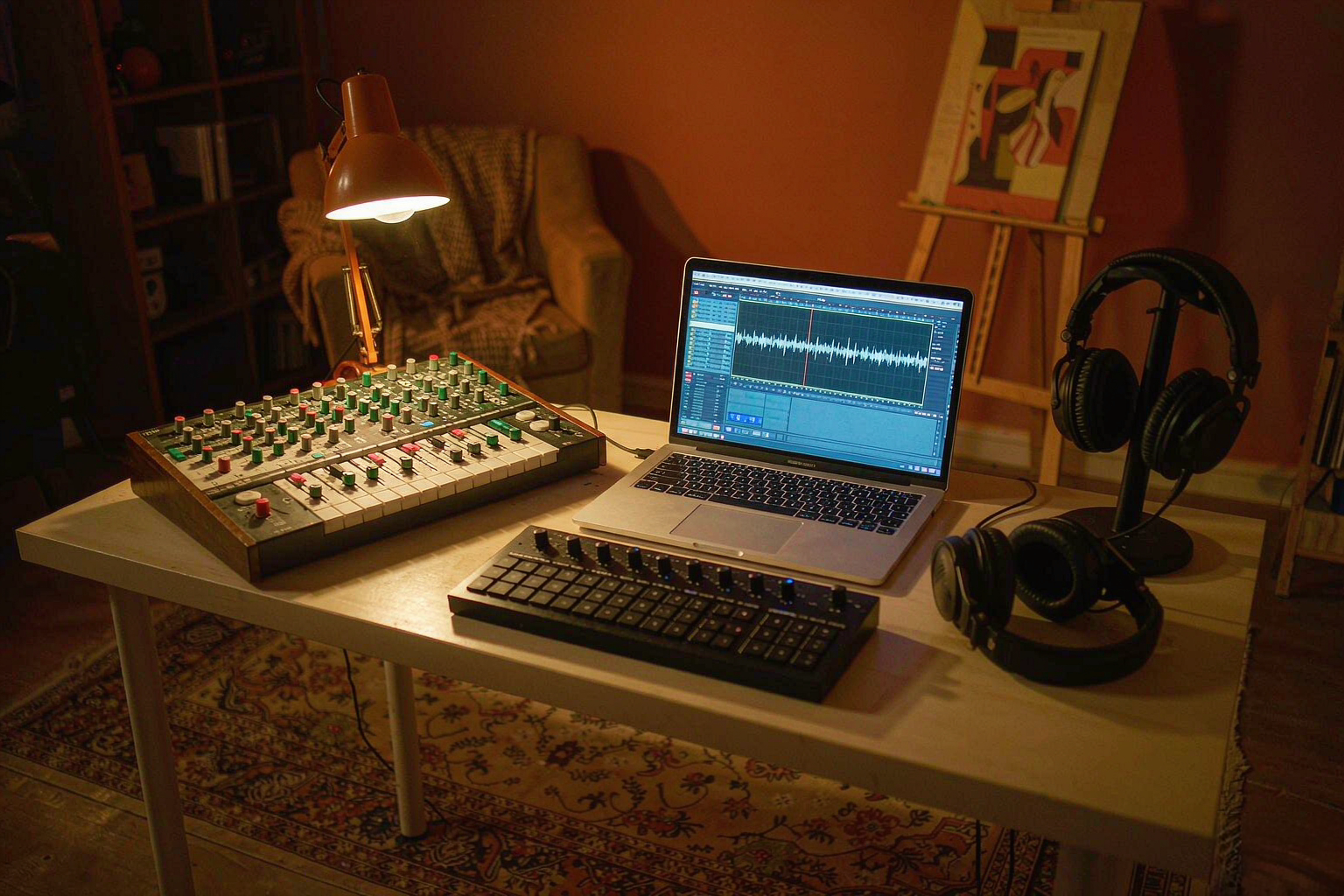
The second thing this family rewards is space. Tracks develop through eight- and sixteen-bar blocks where the payoff is rhythmic or textural rather than narrative. Filter sweeps, risers and breakdowns do the storytelling that a guitar or piano would do elsewhere, and the words are better placed in the gaps those elements leave. A verse that fills every beat fights the mix, and the mix always wins. Practical consequence: write less than feels natural, then repeat the strongest fragment instead of adding new lines.
The third thing is tempo math, and it is the reason one generic “electronic generator” was never going to be enough. A vocal written for a 128 BPM house groove can hold four or five syllables a bar and still sound like speech; that same line at 174 collapses into a machine-gun exercise. Go the other way to 85 BPM for chillstep and suddenly you have room for whole sentences and long, unhurried vowels. Fourteen tools below each know their own tempo range, section length and emotional register, so you get output that scans before you touch it.
Everything here produces original lyrics as a first draft — no existing songs, no artist imitation. Your edit is what turns a draft into your track, and the workflow at the bottom of this page is built around exactly that.
How to use these generators
The short version: brief for a loop, then edit against the drums. Give the tool your tempo and section length alongside the feeling — “124 BPM, eight-bar vocal loop for a deep house track, about quitting a job you were good at” beats “a song about freedom” every time. Ask for the smallest useful unit: a hook phrase, eight bars of verse, one line to sit before a drop. Pieces assemble better than a generator can guess in one pass, and you’ll rewrite most of it in the DAW anyway.
Then do the check that actually matters: speak the line over your drum pattern at real tempo, with the mids rolled down. Your ear will find consonant clusters that fight the snare faster than your eye ever will — and the fix is almost always fewer syllables, never more adjectives.
All 14 electronic lyric generators
Each tool below opens the full generator with its style prompt pre-loaded. The one-liners describe what the tool is tuned for, not a limit on what you can ask it.
- House Music Lyrics GeneratorFour-on-the-floor warmth with room for full sentences, call-and-response and a soulful repeated hook.
- Techno Lyrics GeneratorSteady, hypnotic repetition where a short phrase acts as another drum machine.
- Trance Lyrics GeneratorBig open vowels and uplift — lines built to resolve at the same moment the lead does.
- Dubstep Lyrics GeneratorHalf-time space before impact; sparse build lines and one sentence saved for the drop.
- Drum and Bass Lyrics GeneratorFast breaks and clipped phrasing — short fragments that ride the drum pattern instead of leading it.
- Future Bass Lyrics GeneratorPitch-bent, bright and emotional; vowel-forward hooks that ride a wobbling chord stack.
- EDM Festival Lyrics GeneratorChant-ready inclusive lines — second person plural, one idea, hands-up refrain.
- Nu-Disco Lyrics GeneratorGlossy retro-futurist funk with playful swagger and a chorus built for a glitter ball.
- Synthwave Lyrics GeneratorNeon skylines, wet asphalt and analog nostalgia, written for a night drive at 4am.
- Vaporwave Lyrics GeneratorFragmented, ironic slogans — slowed-down muzak melancholy and deliberate emptiness.
- Ambient Electronic Lyrics GeneratorAlmost-wordless texture; breath-length lines meant to dissolve rather than resolve.
- Chillhop Lyrics GeneratorLo-fi calm with small domestic detail laid over a dusty, slightly late loop.
- Chillstep Lyrics GeneratorMelodic bass with a soft heart; restrained emotional lines under a wide reverb.
- Night Drive Lyrics GeneratorMotion imagery for late roads — headlights, road signs and thoughts you only have alone.
What actually changes between electronic substyles
Treat “electronic” as one dial from mellow to aggressive and the words will betray you. House sits near 120-128 BPM, and that range is why house writing can borrow from soul and disco: there’s room for a full sentence, a call-and-response, even a small story told across a breakdown. It’s the most conversational style here, and it’s where a first-person narrator with actual details still fits.
Techno goes the opposite way. It runs steadier and asks the vocal to behave like percussion — one short phrase, repeated, sometimes processed until meaning matters less than mouth-feel. A clever line is actively worse than a blunt one here, because cleverness pulls attention out of the groove. This is also why so much classic club writing consists of two words, arranged rhythmically, said with conviction.
Drum and bass compresses everything: at 170-plus, full sentences are physically impossible to deliver cleanly, so the style lives on fragments, internal rhyme and rhythmic placement. Vaporwave and ambient electronic pull toward the other extreme, where words are texture — slogan fragments, half-heard phrases — and silence is doing most of the work. Trance wants the biggest emotional vocabulary in the family but the fewest words, because the uplift is melodic. Five styles, five definitions of a good line. That’s why this page has fourteen tools instead of one.
Techno
Expect a two-to-four word phrase, repeated across eight-bar blocks and treated as rhythm. The test isn’t whether the line means something on paper — it’s whether it lands cleanly on the downbeat with your consonants softened.
House
The one club style that can carry a real conversation, thanks to its mid-tempo groove. Full sentences, second person, call-and-response ad-libs and a hook built around open vowels all belong here.
Ambient Electronic
Here the vocal is another pad. Long tones, few words, no rhyme pressure and no narrative payoff — lines should fade into the mix rather than announce themselves.
Words against a kick drum
Syllable density is the craft skill almost nobody practices. Count what your tempo allows: around 124-128 BPM you get roughly four comfortable syllables a bar before the phrasing starts sprinting, and at 174 you’re down to short fragments carried mostly by rhythm. So place your words deliberately — keep the line that lands just before the drop short, vowel-open and ending on a stressed downbeat, and save your densest writing for breakdowns where the drums briefly get out of the way.
The harder lesson is trusting repetition. In verse-driven pop, repeating a line feels lazy; here the repeat is the meaning, because the listener hears the phrase against two minutes of changing production and reads it differently each time. The site’s write-up on techno minimalism makes that argument properly. And once you accept the short loop, craft shifts to placement — the house hook-craft guide breaks down where a phrase should sit inside a bar for maximum lift.
A workflow that works
- Pick the substyle generator that matches your tempo and function, not just your mood — a downtempo vocal over an ambient bed and a 174 BPM roller are different writing jobs, not one job at two speeds.
- Brief with BPM, bar count and one concrete scene. Constraints improve output; open briefs produce lines that could sit on any track in any key.
- Write the hook phrase first, then generate two short units around it — a verse loop and a pre-drop line. Don’t ask for a finished pop structure.
- Import the rough vocal and speak it over your drums at real tempo. Cut every consonant cluster that fights the snare, regardless of how good it looks.
- Keep the best 40%, rewrite the rest in your own voice, and check it on phone speakers before you master. The draft’s job was to get you past the blank project.
Related reading from the WrittenTone blog
- Dubstep Drop Lyrics: Iconic Lines, Hidden Meaning, and How to Write Your Own
- The Poetry of Feeling: How Trance Lyrics Craft Emotional Catharsis
- Techno Lyric Minimalism: When Less Words Hit Harder
- Engineering the House Music Lyric Vibe: A Songwriter’s Field Guide to Intentional Hook Craft
- Songwriting lyric generators: form, rhyme and structure tools
Electronic lyric generator FAQ
- Can one of these write a whole track’s vocals?
Yes, but club arrangements rarely need it. Most producers here want a hook phrase plus two or three supporting lines, because long instrumental sections leave a full verse lyric sitting awkwardly in the arrangement. Generating short units and assembling them yourself gives better results for about the same effort.
- How many words should an electronic vocal have?
Fewer than you think, and the number depends almost entirely on tempo. A house hook comfortably holds four or five words per bar; techno often uses two or three total, repeated; drum and bass wants fragments rather than clauses. Every tool states its default density, and you can override it in the prompt.
- Do these work for mostly instrumental tracks?
That’s a common use. Ask for a single spoken phrase, a texture line or a short chant instead of a verse, then treat the audio like any instrument — chop it, pitch it, bury it in reverb. The ambient electronic, techno and chillstep tools are particularly good at this kind of material.
- Do I need to state a BPM when I brief the generator?
You’ll get much better output if you do. Tempo determines line length and syllable count more than any other single factor, and without it the tool has to guess somewhere between a lullaby and a breakcore record. Include the BPM, the bar length and the section you’re writing for.
The honest bit. These generators produce original first drafts — never reproductions of existing songs, and no artist imitation. Before releasing anything, check the draft for accidental similarity to existing works; with millions of tracks in the world, coincidence is real. Copyright for AI-assisted lyrics has specific rules — the site disclaimer covers them in plain language. And this page is maintained by an actual person: I’m Nico, I test every generator listed here, and the full library of 172 tools is one click away if dance music isn’t the room you’re writing for today.